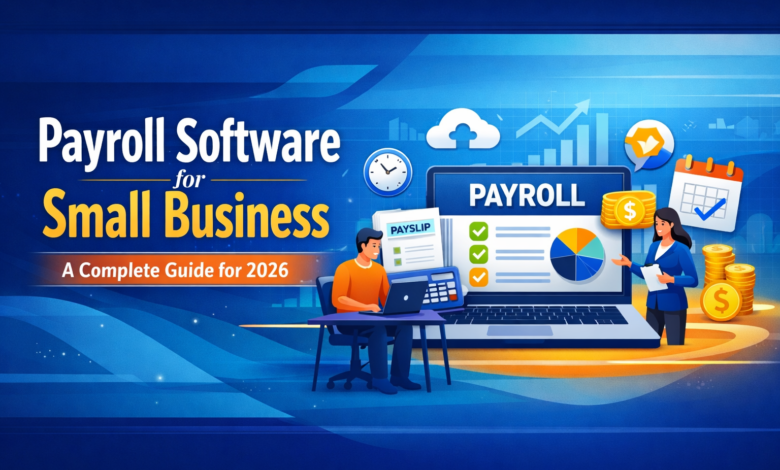
One of the most significant jobs of any small business is payroll management. Employees will be paid on time and in the correct amount, thus fostering trust and promoting adherence to tax laws and employment policies. Nonetheless, manual payroll management is time-consuming and error-prone. As a result, several companies are resorting to modern payroll software to ease their payroll management.
This software enables the automation of salaries, the management of employee records, the generation of tax reports, and the processing of payments in a short time. To save time and reduce the administrative burden, payroll automation can be used by small business owners who already have many responsibilities to attend to.
Here, we discuss the advantages of using payroll software, the features small businesses should be aware of, and some of the best payroll software on the market today.
Why do small businesses require Payroll Software?
Most new businesses at the beginning use a spreadsheet or manual calculations to manage payroll. This could be effective in the initial stages; however, it becomes complex when the firm expands and employs more workers.
Reliable payroll software makes it easier to automate essential functions such as salary computation, income deductions and payment processing. Business owners do not need to spend hours on payroll because the process can be completed in minutes.
Accuracy is another benefit in modern times. Automation of calculations reduces the risk of errors in calculating employees’ wages, taxes, and benefits.
Businesses also have significant concerns about compliance. The payroll systems help ensure that companies comply with tax and labour laws by producing the correct payroll reports and maintaining accurate records.
Professional payroll software is the best investment, especially for small businesses that want to run their operations smoothly without costly errors.
Key Features to Look for in Payroll Software
Not every payroll system has similar functions. There are key features to consider when selecting the best payroll software for the business.
Payroll Processing Automation.
One of the most useful capabilities of the payroll app is automation. Automated systems do not require manual input to determine employees’ salaries, deductions, and bonuses.
This saves on administration and ensures employees are paid the right amount.
Tax Calculation and Filing
Most payroll systems will compute the payroll taxes automatically and produce tax forms. There are even those sites that do tax filing on behalf of companies.
This characteristic assists businesses in complying with tax requirements and avoiding resulting fines due to incorrect calculations.
Employee Self Service Portal.
Most current software solutions have employee portals where employees can view payroll, tax filings and other personal data.
This will reduce the HR workload and enhance communication between employees and management.
Data Protection and Security.
Payroll information contains sensitive employee data, such as bank account details, tax information and salaries. A trustworthy payroll system should offer robust data security and encryption to protect this data.
Best Payroll Software in Small Businesses.
The following are some of the most popular payroll software used by small businesses around the world.
Gusto
Gusto is credited as one of the best payroll software options for small-scale businesses. It has an easy-to-use interface and strong payroll automation capability.
Using Gusto, businesses can handle payroll, administer employee benefits, and file payroll taxes without additional human involvement. Onboarding of new employees and handling of HR functions are also available on the platform.
Gusto is easy to use, which is one of the reasons why it is so popular among small companies. This platform can be used by even those businesses that do not have a dedicated HR department.
Gusto is still one of the best payroll software to use in modern times due to its automation features and user-friendly design.
QuickBooks Payroll
QuickBooks Payroll is another widely used payroll software for small businesses. It is compatible with the QuickBooks accounting system and is thus very suitable for companies that are already on the QuickBooks financial management.
This payroll system will provide automatic payroll computation, tax submission and direct deposits for employees. It is also easy to track employees’ hours and create payroll reports with the help of the business.
A major strength of QuickBooks Payroll is its compatibility with accounting software, which has helped businesses maintain accurate financial records.
QuickBooks Payroll is an effective payroll software for small businesses interested in an all-in-one financial application.
ADP Workforce Now
ADP Workforce Now is an all-encompassing payroll software platform for businesses in countries worldwide. It provides workforce analytics, payroll processing and HR management in one system.
ADP payroll software automatizes payment of salaries, the calculation of taxes and the reporting of compliance. It also entails employee scheduling, benefits administration and performance monitoring tools.
ADP regularly works with small firms, even though larger businesses tend to use its services.
ADP Workforce Now is among the most reliable payroll software providers in the world due to its features and dependability.
Paychex Flex
Paychex Flex is also an effective payroll software platform that helps businesses simplify payroll management.
The system has automated payroll, tax management, and self-service services for employees. The cloud-based system allows businesses to handle payroll using any device.
HR services are also offered by Paychex Flex, which can be useful when a small business needs advice on handling employees.
Paychex Flex is viewed as one of the most trustworthy payroll software options, which growing companies can use for its flexibility and scalability.
OnPay
OnPay is free yet robust payroll software specifically designed for small businesses.
The service has limitless payroll processing, automated tax filing, and benefits management. Employers can also produce payroll and manage employee records easily.
OnPay is unique for its clear pricing and wide range of features. Despite its lower price, it offers tools that can be seen as competing with those of larger payroll platforms.
OnPay is great payroll software for small companies seeking a cost-effective payroll management solution.
Conclusion
Payroll management is a very important activity of any business, and it does not necessarily have to be complex. Modern payroll software enables small businesses to automate the processing of payroll, minimize errors and ensure that they comply with tax regulations.
Gusto, QuickBooks Payroll, ADP Workforce Now, Paychex Flex, and OnPay are examples of solutions that offer powerful tools to simplify staffing processes and payroll management for growing companies.
By selecting the appropriate payroll software, small business owners can save time, improve financial accuracy, and ensure their workers are paid correctly and on time.
With ever-changing technology, payroll automation will be even more relevant in helping businesses operate efficiently and focus on long-term success.
What is payroll software?
Payroll software is an online program that assists companies in automating payroll tasks, including computing salaries, deducting taxes and paying employees.
Why do small businesses need payroll software?
Small business owners rely on payroll programs to save time, eliminate errors, ensure tax compliance, and manage payroll effectively.
Is payroll software expensive for small businesses?
Several payroll solutions offer small-business plans that are affordable. Some solutions also grow with your company.
Can payroll software handle taxes automatically?
Yes, the majority of modern payroll software packages handle payroll tax calculations and tax return filing on their own.




One Comment