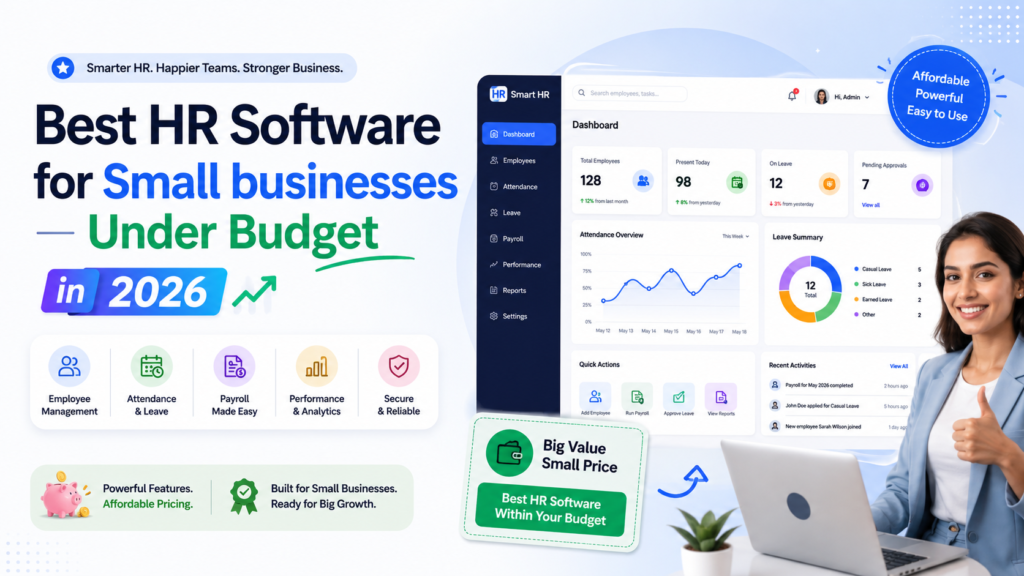
Are you looking for the best HR software for your business? Then this blog is right for you.
Managing a small business in 2026 is no longer just about selling products or services. Businesses are now expected to have a similar control on their hiring, payroll, employee wellbeing, compliance, and productivity, even when working with remote teams, as large business corporations. This can be a lot to handle for small businesses and startups that don’t have a lot of money to spare. This is the reason why investing in the proper HR software for small businesses has become even more crucial than ever.
Many small companies depended on paper, manual procedures, and spreadsheets for managing employees a couple of years ago. Those can still be effective for very small teams, but can become issues as businesses expand. From payroll mistakes to forgotten leaves, missed records, compliance challenges, delays, and poor employee communication can hinder efficiency and hurt company culture.
The contemporary HR systems are addressing these issues by providing cost-effective automation options tailored for startups and SMEs. Today’s cloud-based HR software is user-friendly and adaptable for expanding organizations in the USA, the UK, and Europe.
There are many platforms out there nowadays with all the functions you need: payroll automation, onboarding systems, employee self-service, performance monitoring, and compliance help, that are available at a reasonable price, say, a monthly cost. The right HR for startups and SMEs looking to grow efficiently can be one of the most important investments that a business makes.
Why Small Businesses Need HR Softwares in 2026
The workplace has undergone a significant transformation over the last few years. Even a small company that uses remote work, hybrid teams, flexible schedules, and international hires. Meanwhile, workers want to experience easier digital interaction with employers. Firms with a strong dependence on manual processes may have a hard time keeping up with these expectations.
One of the most important items of value for small businesses is time. Most of the time, owners and managers have to deal with numerous responsibilities simultaneously, meaning HR-related tasks can become a time-consuming distraction. When done manually, employee onboarding, the processing of payroll, attendance, and compliance documents can take hours each week.
This is where HR tools for small businesses come into play. They streamline repetitive tasks, minimize employee error, and manage employee data from a single secure platform. HR operations can be managed from a single dashboard, eliminating the need for paperwork and spreadsheets.
Compliance is another big driver for businesses to invest in HR software. Employment law and payroll rules are constantly changing in the USA, UK, and Europe. If a small business does not have proper systems in place, it may inadvertently be breaking the laws regarding labour, improperly handling tax documents, or be missing employee documentation. Today, HR software can help companies remain compliant and eliminate administrative hassles.
Employee experience is also important. The new workers expect digital onboarding, easy access to payslips, online leave applications, and clear communication. HR platforms enhance the employee experience by offering self-service access and mobile tools that streamline daily interactions with employees.
What Makes Good HR Software for Small Businesses
Not all HR platforms are suitable for small businesses. There are also some enterprise systems that are costly and complicated, and don’t necessarily include features that startups may never need. Small businesses require solutions that are practical, affordable, scalable, and manageable.
The top low-cost HR management software typically emphasizes automation and simplicity. Unlike complex enterprise platforms, these solutions simplify the key HR processes without burdening users with sophisticated tools and applications.
Automating payroll is one of the most helpful options for small businesses. Payroll calculations, tax deductions, and direct deposit can all be handled automatically, minimizing the likelihood of payroll errors. Businesses save time and allow for correct and timely employee payment.
Another crucial function where HR software can be extremely beneficial is onboarding. New employees can access forms, upload documentation, sign contracts, and more, all online. This makes the hiring process easier and more professional, and saves on paperwork.
The management of attendance and leave is also vital. It is common for small businesses to find it challenging to keep track of employee schedules, paid time off, and sick time on the back of manual records. HR systems streamline these and ease managers’ approval workflows.
Self-service is also rapidly gaining significance for employees. Access to personal records, payslips, leave balances, and company documents is made available via secure online portals, eliminating the need to reach out to HR departments for every minor job.
BambooHR: Simple and Reliable for Growing Teams
BambooHR is one of the most popular choices among small businesses due to its simplicity and simplicity. Many startups select BambooHR becasuse it gives vital HR capabilities without the feeling of being overwhelming or too technical.
The system brings employee data together in one place, handles onboarding tasks, records time off, and facilitates performance management. It has a great many advantages, but foremost is its ease of use. If your company is small and doesn’t have human resources experts, you may want to choose a system that is easy to pick up for your employees and managers.
BambooHR also has great reporting options, allowing businesses to track employee information and workforce trends. Attendance, employee directory, hiring, and other info is easily accessible on a single dashboard for managers.
It offers a streamlined and user-friendly experience for small businesses that are looking to move beyond spreadsheets and manual HR processes. The software is particularly beneficial for companies with an HR focus that aim to enhance the employee experience without compromising operational efficiency.
Gusto: Affordable Payroll and HR for Startups
When it comes to cheap HR software for startups, Gusto consistently stands out as one of the strongest options, especially for businesses in the United States. Gusto integrates payroll and basic HR on a single cost-effective platform.
Payroll is one of the most stressful jobs for small businesses, as even the smallest errors can cause financial and legal issues. Gusto automates tax calculations, salary payments, deductions, and filing, making payroll processing easy and straightforward. It can save companies from having to perform manual work, but still keep the numbers correct.
It also has features for employee onboarding, benefits management, and time tracking. When you’re a startup with a small team, it can save you time and money to have payroll and HR combined in a single system.
Transparency is another factor that makes Gusto so popular with startups. Simple pricing models and no-complicated installation processes are preferred by many small businesses. However, Gusto provides both, making HR automation easy to adopt for non-technical business owners.
While it may not be as fully-featured as some of its international counterparts, Gusto is still one of the most cost-effective HR solutions on the market for small businesses in the USA.
Rippling: Powerful Automation for Scaling Businesses
Rippling is growing in popularity with fast-growing startups and remote-first businesses. Rippling HR is different from standard HR software, as it combines HR, IT, and finance management into a single platform.
There’s one of Rippling’s most significant benefits, and that’s automation. Automate onboarding workflows, payroll, software access, and device management from one dashboard. This is particularly useful for technology startups and remote businesses with a distributed workforce.
Rippling also has excellent integrations. The platform can be integrated with hundreds of workplace applications, enabling seamless workflows within different business departments.
Scalability is an excellent feature for startups that are looking to grow their businesses quickly. The software is planned to support growing teams without complicating the operations.
But Rippling might seem more sophisticated than some very small companies’ simple HR requirements. This means that small businesses might choose to use simpler solutions, while scaling startups can be extremely useful when it comes to Rippling’s automation capabilities.
Deel: Great for remote and international teams.
With the rise of remote work, businesses have changed the way they hire their employees. Today, many startups are choosing to hire talent from overseas rather than hiring from the local talent pool. This change has boosted the need for international payroll and compliance services.
Deel has become one of the top HR software companies for remote companies worldwide. The software specializes in international hiring, contractor management, and global payroll processing.
Deel makes hiring staff abroad seamless for European startups and remote work organizations. Employers can get workers or contractors from various countries without getting into legal trouble with local labour laws.
Deel also provides international payments, contracts, tax documentation, and help with compliance. This will ease the legal and administrative burden of worldwide hiring.
With remote work growing in the USA, UK, and Europe, tools like Deel are vital for startups with global teams to collaborate.
Zoho People: Budget-Friendly HR for SMEs
If you’re looking for the best HR solution for your business that won’t break the bank, Zoho People is a strong choice. The platform has a multitude of core HR capabilities at a lower price point than most of its competitors, making it perfect for budget-sensitive SMEs.
Zoho People features attendance management, leave tracking, workflow automation, employee database, and mobile access. The platform’s integration with other Zoho products is beneficial for small businesses that already utilize them.
Accessibility is one of the best features of Zoho People. The software can be applied to small businesses without the massive financial commitment, and still gain from better operational efficiencies.
While it doesn’t provide as many advanced analytics or user-friendliness as the more expensive platforms, it’s a great option for startups seeking to offer practical HR capabilities at an affordable cost.
Employment Hero: Strong Option for UK and European Businesses
The HR industry has become more popular in the UK and European markets due to Employment Hero’s affordability and built-in HR tools. It’s one platform that integrates payroll, recruitment, compliance management, employee engagement, and learning solutions.
Businesses prefer Employment Hero as it is user-friendly without breaking the bank. For businesses looking for specific payroll and compliance services in the UK and Europe, the platform can be of great value.
Ongoing changes in the European work environment require companies to have HR systems that support compliance with current and future requirements. Employment Hero offers solutions that help SMEs do these things more efficiently and effectively to improve workforce management.
Conclusion
For growing startups and SMEs, selecting HR software for small businesses is no longer an option, but a necessity. Efficient systems are essential for companies to thrive in today’s competitive market, as they minimize administrative tasks, enhance employee satisfaction, and foster long-term success.
There are numerous cost-effective HR solutions that can accommodate the needs of a business, whether it is automation, managing remote workforces, streamlining onboarding processes, or ensuring compliance. Each platform has its own strengths and weaknesses for businesses of different sizes and requirements, including BambooHR, Gusto, Rippling, Deel, Zoho People, and Employment Hero.
Not all HR software is necessarily the most costly platform. One of the keys to success for many small businesses is the ability to find a solution that is not only affordable but also easy to use, automated, and scalable.